Thursday, May 30, 2013

Good To Great


Image courtesy of composecreate.com
I don't care if you are a CEO of a Fortune 500, the leader of a start-up, middle management, or have little to no role in business whatsoever, Jim Collins' Good To Great is worth your time to read.
Why?
The principles described in this book go far beyond the business world. If you have any desire to create greatness in any area of your life, this book can be a valuable resource. If it is something as seemingly far removed from business as creating a great sports team or even being a great parent/creating a great family, the basic principles in this book can help guide you.
What is Good To Great?
In a nutshell, Collins took a team of people and researched the question, "What allowed companies that were getting good results to all of a sudden get great results?". Essentially, they were looking for things that specific companies had in common during the time when they made the jump from good to great, as measured by how well each company's stock did compared to the rest of the market.*
What they found were essentially seven principles that all of the Good-to-Great companies followed and then related it all back to Collins' earlier work, Built To Last.
These are the principles that set companies like Walgreens and Wells Fargo apart from their competitors, that allowed them to go from getting mediocre results to getting extraordinary results. And these principles have application to almost any field imaginable.
In what area of your life do you want to make an impact? In what area to you want to be great?
Enjoy this review? Get a copy of Good To Great in the Self Made® Book Store!
Want to use this article in your blog, newsletter, or other platform? You may, but be sure to include all of the biographical information found in the yellow box below!
*For more details on the actual mechanics of the study, please read the book. I was far more interested in the takeaway messages and principles for the use of this post as well as my own life so I tended to skim over most of the information on the study itself.

Wednesday, May 29, 2013

"Supertraining" and Machines: Part 2


Image courtesy of heroturko.me
In Part 1 I discussed the issues I saw with the FR machines section in section 4.2.7 of Supertraining, specifically the gross misunderstanding of motion and forces.  Now I'd like to dive into my thoughts on what Verkhoshansky and Siff called the Non-Functional Resistance (NFR) machines.
I suppose if I am going to pick a place to start dissecting this section, I might as well start at the beginning.  Sentence #1 reads, "...in general (NFR machines) are unable to provide the same degree of multi-dimensional, full range, neuromuscular and musculoskeletal training as free weights and 'functional' machines."* (Verkhoshansky, 238).
Critiquing this half sentence will be an entire post itself.
Okay so let's start with "multi-dimensional".  I'm going to make the reasonable guess that what they mean by this is the fixed path of motion of machines does not allow for motion outside of that design, unlike FR machines (cables) and free weights.  Two thoughts with this:
1. They haven't been introduced to the Cybex Eagle press, as demoed here by my friend Ben:
Image courtesy of fitbie.msn.com
2. They don't understand the concept of virtual restraint.  Virtual restraint can come into play in a lot of different exercises, such as squats, but it's relevance to this point is when performing pulling exercises with heavier loads using a cable** or "free" weights.  When the load becomes heavy enough using either tool**, there will be one and only one path along which you can move that weight in the manner you are trying to--the path that optimizes the moment arms to every joint so you can perform the desire motions.
Test this out by performing a single arm dumbbell row.  First, using a lighter weight, try to pull the dumbbell so your hand ends up by your shoulder.  Next, try to pull the dumbbell so your hand ends up back by your hip.  If the weight is light enough, this should be a reasonable task.  Now try the same thing with a dumbbell that is highly challenging for you to row. (**Don't actually do this if you aren't prepared to.**).
Were you able to move that dumbbell as freely as you could the lighter one?  Doubtful.  When the load becomes great enough, that dumbbell will become just as restrained to a single path of motion as any machine--and even more restrained than those with the Cybex dual axis technology! Ha, but seriously.
Alright, on to "full range" now.  I think maybe the easiest way to answer this is just, "No", but I suppose I should expand.
Full range:  Are they talking of a joint or are they talking of a muscle?  Regardless, it seems like they are presenting an argument more for a "full range" challenge than "full range" motion.
Here's a beautiful thing about well made strength machines--they offer a varying magnitude of challenge as you move throughout it's designed path of motion, the likes of which (if it is a quality machine) will provide a greater challenge in the parts of the motion where you are able to generate more tension and less of a challenge in parts of the range where you are able to generate less tension.  This allows for a much greater range of motion that can be appropriately challenged instead of feeling like it is almost unbearably difficult at one point in the range and then a complete cake walk throughout the rest of the range.
While free weights and cables allow for this change in challenge, too, unless you understand how to set the exercise up to provide the challenge that you want, rarely will you find that either of these tools is appropriate for challenging a larger range of motion.
Image courtesy of stack.com
Take the barbell back squat, for example.  This loaded movement (as if there were only one way to perform it) is most difficult in only one spot and how much load you can challenge yourself with is completely dependent on your ability to handle it at that one spot.  Moreover, as you move ascend up from that one spot and are able to handle more load, the challenge becomes less.  While you can add bands to increase tension as you ascend out of the bottom of your squat, understand that 1000 lbs times a zero moment to the joints controlled by the tissues you are trying to challenge equates to no challenge to those tissues.  So even with bands you still have to understand how to create the challenge you are looking for in order for them to be as effective as they can be in terms of altering the challenge throughout the range.
Okay, finally on the last bit--"neuromuscular and musculoskeletal training".  To me it seems as if they are saying that your muscles, skeletal structure, and nervous system won't reap as much benefit from using NFR machines as they will from using FR machines and free weights.
Look, if you develop quads that can generate more tension from performing knee extension on a machine, then you have stronger quads.  And those quads and that strength, you can use it wherever you want.  You don't magically lose that strength because you stand up out of the knee extension machine and move on to squats, for example.  It's not about the tool that you used to develop the strength.  Whatever adaptations you create using any tool you get to use when using other tools.
As discussed above, in terms of appropriately challenging tissue throughout a larger range of motion machines will often reign superior over free weights and cables.  So then the question becomes are you trying to create an adaptation where you are stronger throughout a larger range of motion or only at very specific points in that range?
Stronger muscles means more force that can be applied into bone, which leads to stronger bones.  And as far as the nervous system is concerned, I'm not really sure what they mean by this.  Are they saying your brain won't be able to figure out how to use stronger muscles to produce motion?  I don't think that will be the case.  Or are they talking about explosive movements and speed work?  Why can't you do speed presses on a chest press or do speed work on a leg press or knee extension?  At least with those tools there will be a greater opportunity for a greater challenge to be presented to the tissue.
So there you have my thoughts on that one half-sentence.  Up next, critiquing the rest of the NFR section.
What kind of adaptations opportunities do you think are provided by free weights and cables that aren't provided by machines?
Like this post?  Drop a comment below and “Like” Self Made® on Facebook!
Want to use this article in your blog, newsletter, or other platform?  You may, but be sure to include all of the biographical info found in the yellow box below!
*Verkhoshanski, Yuri; Siff, Mel.  Supertraining, Sixth Edition–Expanded Version.  2009.  p. 237-240.
**The virtual restraint imposed by trying to pull a heavy load attached to a cable will be more conic in nature than the virtual restraint imposed when trying to pull a heavy dumbbell.  In other words, when performing a heavy cable row, there were be fewer and fewer options for motion available as you pull your hand towards yourself.

Tuesday, May 28, 2013

'Tis The (Flip Flop) Season

Image courtesy of inbop.com
Whether you consider post-Memorial Day to mark the start of summer or hold off until it officially turns in late June, almost one thing is for certain: flip-flop season is in full swing. And while this lightweight form of footwear can have you feeling footloose and fancy free, what repercussions are potentially on the horizon by sporting the open-backed staple of summer?


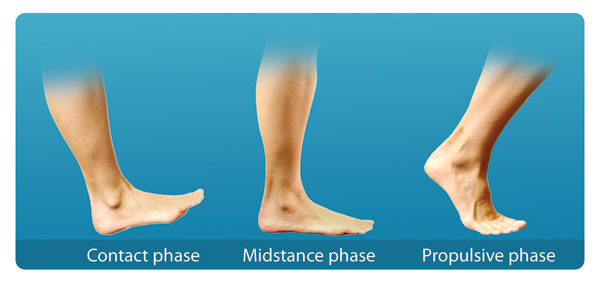
First, let's talk about what is supposed to happen to your foot when you walk. In a very elementary sense, when you rock forward over your foot that is planted to the ground your toes are supposed to be allowed to stay flat to the ground (extend) while the longer bones of your foot (metatarsals) will point down (plantarflex) as your heal lifts off the ground.
Image courtesy of naturalrunningcenter.com
However, when you wear an open-backed shoe such as flip-flops, your toes have to claw or grab at the shoe in order for it to stay on your foot. Unfortunately, this is often happening when your toes are supposed to be straight.

Because your toes are flexed when they are supposed to be extended, your metatarsals are unable to plantarflex, which disrupts the ability of your foot to become a rigid lever, further disrupting your ability to efficiently roll forward through gait.

These altered foot mechanics have far too many potential consequences to list, but in general I think it would be fair to say that by altering the mechanics of the joints of the foot during gait, the forces being imposed across these structures are not ideal for the long term well-being of these structures, the degradation of which may lead to different types of bone growths as well as other orthopedic issues as your body tries to compensate for the stresses being placed upon it.

So, is this post trying to get you to throw out all of your beloved flip flops and other open-backed shoes?  Not exactly.  But it is trying to educate you on the potential consequences of regularly wearing the season's most common form of footwear.

And if you feel the need to consistently wear your flops, at the very least do yourself the favor of trying to ensure that your feet are as well-supported by your muscles as they can be by setting up a tune-up with your local Muscle Activation Techniques™ specialist.

While having all of your foot and lower leg muscles working optimally won't necessarily alter the need to grab on to your flops with your toes every step, it will help to make sure those issue aren't compounded by giving your foot the best chance possible to work as ideally as it can once you remove the open-backed shoe.

Are your feet (and ankles and knees and hips and spine) ready to rock your flops all summer?

Interested in finding out more?  Check out the Muscle Activation Techniques™ page!

Interested in setting up an assessment or discussing this subject further?  Leave a comment below or e-mail Charlie at charlie@selfmadefitness.com!

Your body.  Your training.

Like this post?  Drop a comment below and “Like” Self Made® on Facebook!

Want to use this article in your blog, newsletter, or other platform?  You may, but be sure to include all of the biographical info found in the yellow box below!

Wednesday, May 22, 2013

Think and Grow Rich


Image courtesy of crnobelo.com
Napoleon Hill's Think and Grow Rich is one of the most highly-acclaimed wealth mastery books ever written.  Anthony Robbins says attaining financial freedom is 20% mechanics, 80% psychology.  Think and Grow Rich addresses the latter.
How do you think and feel about wealth?
How do you think and feel about money?
What are your biggest financial fears?
Think and Grow Rich addresses these questions and more, identifying what may be your biggest limitations in increasing your net worth and guiding you through reasonable and proactive solutions.
My biggest worry when I first got this book was it was going to be about more or less making money appear with your mind.  While one could make an argument that this is true, to me what it was really about was addressing how you as an individual feel about money and wealth.  Money can be a very sensitive subject for a lot of people and this book tries to ease that sensitivity.
I have stated before that I am a big believer in the power of thoughts, mindset, and energy, so if this kind of stuff vibes with you as well then this book is a must-read.  Additionally, if you feel like all you do is work really hard but haven't been able to increase your income you should check this book out.
Enjoy this review?  Get a copy of Think and Grow Rich in the Self Made® Book Store!
Want to use this article in your blog, newsletter, or other platform?  You may, but be sure to include all of the biographical information found in the yellow box below!

Tuesday, May 21, 2013

"Supertraining" and Machines: Part 1


Image courtesy of heroturko.me

I was skimming through my copy of Supertraining by Yuri Verkhoshansky and Mel Siff this morning and thought it would be be interesting to check out their take on using machines and strength training.  Despite the respect this book has garnered from the strength and conditioning world, there were some MAJOR errors in the understanding of the application and effects of strength training machines.
Just a quick side note before I dive in:  I am going to try to keep this post short(er), so I'm not going to hit all of the points from this section of the text (4.2.7, 6th edition-expanded version) today, but I plan on expanding on this post in future posts.

So the authors started by classifying strength training machines as either 1) Functional Resistance (FR) Machines or 2) Non-functional Resistance (NFR) Machines (Verkhoshansky, 237).  The difference between the two was stated as "FR machines offer resistance in sport specific patterns" whereas "NFR machines offer general resistance in non-sport specific patterns"* (Verkhoshansky, 237).  The argument that was made over the next few pages is that using FR is a superior means by which to train athletes in order to prepare them for competition.

Image courtesy of mystrengthtraining.com

An example of FR was said to be a cable and pulley system (excluding traditional lat pull-down machines) as compared to examples of NFRs which were said to be seated knee extensions, biceps curl machines, and leg presses.

The entire point of the section was to answer the question, "Which classification of machine would better-prepare athletes to perform the movements of their sport?".  The overarching conclusion was stated as, "The important limitation of many strength training machines is that they are designed to train muscles, not movement.  Because of this, they are not the most important training tool for athletes."* (Verkhoshansky, 237).

I looked at this statement and my first thought was, "Muscles perform movements, so by improving the way muscles perform are you not giving yourself the best opportunity to improve movements?"

In an interesting twist at the end of the first section, the authors write, "In using any machine, however, it is vital to note that simulation of any sporting movement against heavy loads can alter the force-time characteristics of the action significantly and disrupt the neuromuscular programmes responsible for movement."* (Verkhoshansky, 238).

To me this is implying that the use of FR machines is not to actually get stronger, but to practice motions specific to an athlete's sport.  The kicker with this is that anyone who can see and understand forces will realize that there are very few sport-specific motions (if any) that would actually allow for a single cable and pulley to be added to them (such as the high-low cable given as the example on page 237) and only have a change in the amount of force that has to be overcome in order to perform the motion.  More times than not you will be dealing with a different direction of force, as well, which will alter which muscles are used to perform the motion.  (**An easy example of this is the chest press vs. the row.  Both can be performed as the same motion, but because the direction of the resistance force is different, different muscles are employed to perform the motion.)

This seems to directly contradict the very last sentence in this sections, which reads, "...functionality is not the automatic consequence of a specific exercise, but of the functional objectives associated with using any exercise, irrespective of its similarity to any sports action and integrating it effectively into the long-term conditioning programme."* (Verkhoshansky, 238).

My takeaway from this is that the authors are saying it is not about the motion being performed but rather about the adaptation attained through exercising and how well that adaptation transfers to the improvement of the performance of the athlete.  This, as I stated above, is contradictory to their previous statement where they wrote the goal was to improve sporting motions through adding resistance even though it is likely the added resistance would alter which muscles are performing the motion and therefore the potential adaptation gleaned from the exercise would be different than what was intended.

Okay so that's a brief overview of the first part of this section on machines and the objective of them writing this section altogether.  Up next:  their fatal misinterpretation of the use of "NFR Machines".
Are you seeing forces or are you caught up in the motions?


Like this post?  Drop a comment below and “Like” Self Made® on Facebook!

Want to use this article in your blog, newsletter, or other platform?  You may, but be sure to include all of the biographical info found in the yellow box below!

*Verkhoshanski, Yuri; Siff, Mel.  Supertraining, Sixth Edition--Expanded Version.  2009.  p. 237-240.