Showing posts with label Chicago personal trainer. Show all posts

Tuesday, September 17, 2013

The Aerobic Deception?

Image courtesy of crazyhealthyfit.com
Note:  This post is more of an update on what is running through my head (scary) than an actual factually-based post.

For the longest time I was under the deception that aerobic exercise was "bad".  From creating poor hormonal profiles for muscle building to being an inefficient means of calorie expenditure to the consequences of the almost certain mechanical stresses that were being inappropriately applied to a system, I was not very "pro-aero".

Tuesday, August 27, 2013

"Neuroligically Hardwired" Movements

Image courtesy of lesfemmesportive.wordpress.com
Last week I engaged in an awesome discussion on Twitter regarding my post "Lunges vs. Leg Press". It was essentially three solid days of tweets being sent back and forth between my account and another account discussing our particular view points. Near the end of the discussion, the owner of the other account brought up the idea that movements such as lunges and squats are (paraphrasing) movements that are hardwired into our brain and nervous system.

I have heard this argument before, that these two movements, in addition to others, are being considered "basic human movements". My understanding of statements like these is that squats, lunges, hip hinges, and the like are movements that all humans know how to perform and therefore should take precedence in training and exercise programs. I happen to fundamentally disagree with these thoughts.

Tuesday, August 20, 2013

The Other Half of the Rep

Image courtesy of jfit360.com
A challenge I've been presenting some of my clients with recently is for them to make the movement they are doing as challenging for themselves as they lower the weight as it is for them when they raise it.

Tuesday, August 13, 2013

Articulating The Goal

Image courtesy of fieldacademia.com
Building off of last week's post--"What's The Goal?"--I think the importance of being able to articulate that goal to your client (if you are a personal trainer) needs to be discussed.

Tuesday, August 6, 2013

Friday, July 26, 2013

Shoulds To Musts


Image courtesy of georgejpark.com
*Originally written for the February 2013 issue of "The Source"*
"Everything in your life is a reflection of your musts." -- Tony Robbins
How do you get the car you want?  How do you get the house you want?  How do you create financial freedom for yourself?  How do you improve your relationships with loved ones?  How do you get your health and wellness in order?  How do you start living a happier life?
You turn your shoulds into musts.
This very powerful concept was first introduced to me by Tony Robbins.  Essentially, he says that everything in your life--your health, relationships, financial situation, happiness, etc.--is a reflection of your musts.  What you have chosen that you must have or do compared to what you have chosen you should do.  He says that every single one of us is making as much money as we must make and not a dime more.  Every single one of us has the health and physique that we must have.  Every single one of us is as happy as we feel we must be in order to survive.
Unless we raise our standards and take what we currently believe are actions that we should perform in order to achieve goals that we want to reach and make them actions that we must take in order to achieve goals that we need to reach, those goals will not ever get accomplished.
I have these types of conversations a lot with people who can’t seem to find the time or money to do what they want to do.  As I have said in the past, it comes down to priorities, plain and simple.  How highly do you prioritize your health?  How highly do you prioritize your financial freedom?  How highly do you prioritize your happiness?
Most importantly, how do your actions reflect your alleged priorities?
It seems crazy that any one of us would not want to be healthier, happier, or more prosperous, but do your actions actually reflect that?  You can say you want to do something, but at the end of the day what did you do to actually do it?
Image courtesy of liveyourbestlifeguide.com
When it comes down to it, our actions fully represent our priorities.  Regardless of what we say or how we think we feel about things, we put our time and effort into the areas of our lives in which we want to make the most progress or the areas we value the most.
Step back for a moment and analyze your life.  Where are you putting most of your time and energy?  Block out your week if you have to and figure out how many hours you spend doing the things you do.  After that figure out how much of your energy and focus each of these things demands of you.  Now, the important question to ask when reviewing this data is, “Why are you putting the majority of your time and energy into these endeavors?”  In fact, this question is going to be how you figure out what your true priorities are.
If you find that, for example, you are spending the vast majority of your time and energy at work, you could sit back and wonder why you don’t have more money or why your career isn’t further along.  But, if you are honest with yourself and you answer the question, “Why?” with, “Because I want to be able to pay my bills and I want to go out and have a good time with my friends,” then you have your true answer right there.  You don’t truly prioritize making more money.  You prioritize having enough money to get by and have fun.  You don’t truly prioritize advancing your career.  You prioritize being stable enough in your career to allow you to pay your bills and have a good time with your friends when you want.
And that is completely fine.  Absolutely, completely fine.  But understand that it is fundamentally different than spending the majority of your time and energy at work to actually make more money and advance your career.  This is just one example and I think you can really dig into all areas of your life like this and figure out what is actually driving you to take the actions you take.
This year is a big action year for me.  I am really hyped and in the right mindset to DO some big things.  As busy as I was in 2012, I have HUGE plans and a jam-packed schedule for 2013, so much so that I am already starting to plan for what I am going to do in 2014 because I’m not going to be able to fit it all in this year (there just aren’t enough weekends in a calendar year!).  A lot of things I have thought about doing or wanted to do in the past, this is the year they are going to happen.  This is the year I am going to take the necessary steps to get them done.
Image courtesy of sumsolutions.com
And this is the year you can, too.
Without being too cliche I want wrap this up by saying this moment right here is all you are guaranteed.  It is all you know you will ever have.  So if you cannot take this moment right here and use it to take steps towards accomplishing what you want to accomplish or living the life you want to live, then those things are not of high enough priority for you yet.  You are banking that what is not guaranteed will, in fact, happen.
But let me tell you, when you absolutely have to get something done, you don’t bank on the uncertain.  You see to it yourself that it gets done by doing something about it this very moment.
And until you can do that, until you can take that one should and turn it into a must by raising your standards and expectations and not accepting your current state as good enough any longer... all of the ideas in your head... are just going to stay ideas in your head.
Right now, what is one “should” that you are going to turn into a “must”?
Like this post?  Drop a comment below and “Like” Self Made® on Facebook!
Want to use this article in your blog, newsletter, or other platform?  You may, but be sure to include all of the biographical info found in the box below!

Monday, July 22, 2013

It's Not About The Reps

Image courtesy of vivavitamins.com
"How many reps should I do?"
"I feel like I should be able to do more reps."
"I could do more reps if I didn't have to think about it."

Tuesday, July 16, 2013

Hitting Singles


Image courtesy of gwusports.com

If you played baseball and every time you batted you got a hit and reached first base safely would you be considered a good batter?  In all likelihood, you might be considered the best ever.
Zero doubles.  Zero triples.  Zero home runs.  Zero outs.
How often do we hit singles when we exercise?  Not crushing ourselves trying to swing for the fences.  Not over extending ourselves trying to turn everything into a double.  But just patient with the process, understanding that four singles in a row still scores a run.
How many days have you been out from exercise because you went for the home run a day or two before?
How many runs can you score when you aren't able to play the game?
Like this post?  Drop a comment below and “Like” Self Made® on Facebook!
Want to use this article in your blog, newsletter, or other platform?  You may, but be sure to include all of the biographical info found in the yellow box below!

Tuesday, July 2, 2013

Exercise Is A Stressor

Image courtesy of navstress.files.wordpress.com
A perspective that I have have been developing for a while and have been communicating to others more recently is the idea that understanding and appreciating that exercise is a stressor is of the utmost importance for an exercise professional.


I believe that this is in part what the RTS™ idea of "exercise is invasive" is trying to convey--having the perspective that what we do on the outside profoundly affects the inside and understanding and accepting the responsibility that comes with that.

My application of this idea as of recent has been beyond simply the mechanical stresses that are imposed upon the system when strategically challenging motions and positions.  I think to fully be able to appreciate this idea you have to have some notion of what else in a client's life is creating stress, whether it is them eating foods that don't agree with their system, poor relationships with those they interact with, or a highly-demanding work environment, as well as a lifestyle structure that does not allow for adequate recovery from these other stressors.

Stress, as I am defining it in this context, is "the body's reaction to change that requires a physical, mental, or emotional adjustment or response" (About.com).

Because of this viewpoint that exercise in its most basic form is a stressor, I am of the belief that a huge part of my job as an exercise professional is to manage this stressor for the time a client is with me relative to the other stressors they are currently having to deal with.
Image courtesy of healthonabudget.com
This means that if a client comes in and says they had a really stressful day at work and they need a hard workout to get their mind off it, I stand there and tell them that it would be a breach of my ethical and professional guidelines to do that.

This means that if a client comes in and says they were at holiday parties all weekend so they need an intense workout to get all of the alcohol out of their system and burn of the 40,000 calories in hotdogs, potato salad, and pies they ate, I stand there and tell them that it would be irresponsible of me as a professional to add to the stress that their diet put on their system by challenging them at the intensity they are requesting.

This means that by attempting to take an inside (the body) view of exercise, I cannot see losing weight, improving health, fighting disease, or feeling better as (superficially speaking) eat less move more issues.  Instead, I have to see them as internal environment issues.  Which means I have to know how my tool of choice (force) may potentially affect the internal environment such that I can effectively manage my tool to the best of my ability in order to allow for an internal environment to be created within my clients that allows them to lose weight, improve their health, fight disease, and feel better.

Exercise is a stressor, and with that perspective comes the responsibility of understanding that what you as an exercise professional are doing may be furthering someone's issues, not relieving them.

Your body.  Your training.

Like this post?  Drop a comment below and “Like” Self Made® on Facebook!

Want to use this article in your blog, newsletter, or other platform?  You may, but be sure to include all of the biographical info found in the yellow box below!

Wednesday, June 5, 2013

"Supertraining" and Machines: Part 3


Image courtesy of heroturko.me
There is a lot that could be said about the remaining six paragraphs of section 4.2.7.2 in Supertraining regarding "Non-Functional Resistance (NFR) Machines", but in an attempt to do more than debate every sentence, I want to pick out one concept that is brought up in these paragraphs.  Also, if you haven't already checked out Part 1 and Part 2, now could be a good time to do so.
What I want to discuss is this idea of "stabilizers".  I had an epiphany about this a few weeks back.  See, I used to be very anti-machine and pro-dumbbell and barbell.  And by "used to" I think I really started switching how I view things around February or March of 2012.  There are a number of ironies with this, not the least of which is that I would gladly use knee flexion machines (leg curls) but would stay away from chest presses, leg presses, and every other kind of machine like the plague.
Image courtesy of juranring.co.uk
Looking back, this selective bias towards knee flexion machines and away from everything else was completely void of reasonable logic, but regardless I thought I was sound in my reasoning.  Although until a few weeks ago, I couldn't recall exactly what that reasoning was.
I had multiple discussions with people where they were telling me the exact same thing that I tell people now and where they would use the exact same logic that I use now, but it wasn't clicking in my head at the time.  In fact, I was very against what they were saying.
Finally, after spending over a year trying to remember why I disliked machines so much, it finally hit me one day:  I was under the belief that if you exercised using machines you wouldn't work your "stabilizers".  In fact, for years before I got my first exposure to studying anatomy via the Muscle Activation Techniques™ internship, I thought there were muscles whose sole purpose was to "stabilize" and they would be neglected if I exercised on machines.
Here's the thing:  labeling a muscle a "stabilizer" or "prime mover" or whatever else you want to call it is essentially denoting a muscle's ability to produce or prevent motion around an axis.  Think of it as a continuum where a "stabilizer" has less of an ability and a "primer mover" has a greater ability, but each has an ability.  It's just that one is less than the other.
Image courtesy of iarfonline.com
And because each has an ability, each should have the mechanical opportunity to prevent or produce motion around the axis in question.  This means that when you sit down in a chest press machine, your shoulder "stabilizers" don't automatically shut off as I once firmly believed would happen.
Image courtesy of au.lifestyle.yahoo.com
So what is a possible difference that you may be feeling when doing, for example, a dumbbell chest press on a flat bench compared to a chest press on a machine?  Because of the restraint imposed by the architecture of the machine the amount of skill needed to successfully perform the desired motion is dropped way, way down to almost, if not right at, zero.
With increased passive restraint and decreased skill requirements comes the ability to challenge tissue to a greater degree.  Greater mechanical challenge to the tissue provides the opportunity to develop stronger muscles, which brings us to the question:
**Are you performing chest presses to improve the skill of pressing or to increase the ability of the muscles performing the presses to produce tension (force)?**
Like this post?  Drop a comment below and “Like” Self Made® on Facebook!
Want to use this article in your blog, newsletter, or other platform?  You may, but be sure to include all of the biographical info found in the yellow box below!

Monday, June 3, 2013

It Really Is This Simple


Image courtesy of dangerouslyhardcore.com
It really is this simple.
  1. What is one activity that you like to do?
  2. Do you want to be able to do that activity for as long as you live?
  3. What are you currently doing to give yourself the best chance possible of being able to do so?
Ask yourself these three questions and then ask me how Muscle Activation Techniques™ fits into the picture.
Interested in finding out more?  Check out the Muscle Activation Techniques™ page!
Interested in setting up an assessment or discussing this subject further?  Leave a comment below or e-mail Charlie at charlie@selfmadefitness.com!
Like this post?  Drop a comment below and “Like” Self Made® on Facebook!
Want to use this article in your blog, newsletter, or other platform?  You may, but be sure to include all of the biographical info found in the yellow box below!

Tuesday, May 28, 2013

'Tis The (Flip Flop) Season

Image courtesy of inbop.com
Whether you consider post-Memorial Day to mark the start of summer or hold off until it officially turns in late June, almost one thing is for certain: flip-flop season is in full swing. And while this lightweight form of footwear can have you feeling footloose and fancy free, what repercussions are potentially on the horizon by sporting the open-backed staple of summer?


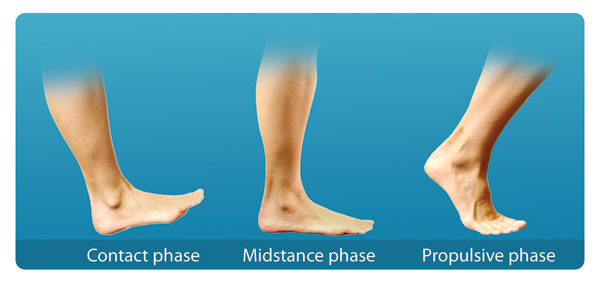
First, let's talk about what is supposed to happen to your foot when you walk. In a very elementary sense, when you rock forward over your foot that is planted to the ground your toes are supposed to be allowed to stay flat to the ground (extend) while the longer bones of your foot (metatarsals) will point down (plantarflex) as your heal lifts off the ground.
Image courtesy of naturalrunningcenter.com
However, when you wear an open-backed shoe such as flip-flops, your toes have to claw or grab at the shoe in order for it to stay on your foot. Unfortunately, this is often happening when your toes are supposed to be straight.

Because your toes are flexed when they are supposed to be extended, your metatarsals are unable to plantarflex, which disrupts the ability of your foot to become a rigid lever, further disrupting your ability to efficiently roll forward through gait.

These altered foot mechanics have far too many potential consequences to list, but in general I think it would be fair to say that by altering the mechanics of the joints of the foot during gait, the forces being imposed across these structures are not ideal for the long term well-being of these structures, the degradation of which may lead to different types of bone growths as well as other orthopedic issues as your body tries to compensate for the stresses being placed upon it.

So, is this post trying to get you to throw out all of your beloved flip flops and other open-backed shoes?  Not exactly.  But it is trying to educate you on the potential consequences of regularly wearing the season's most common form of footwear.

And if you feel the need to consistently wear your flops, at the very least do yourself the favor of trying to ensure that your feet are as well-supported by your muscles as they can be by setting up a tune-up with your local Muscle Activation Techniques™ specialist.

While having all of your foot and lower leg muscles working optimally won't necessarily alter the need to grab on to your flops with your toes every step, it will help to make sure those issue aren't compounded by giving your foot the best chance possible to work as ideally as it can once you remove the open-backed shoe.

Are your feet (and ankles and knees and hips and spine) ready to rock your flops all summer?

Interested in finding out more?  Check out the Muscle Activation Techniques™ page!

Interested in setting up an assessment or discussing this subject further?  Leave a comment below or e-mail Charlie at charlie@selfmadefitness.com!

Your body.  Your training.

Like this post?  Drop a comment below and “Like” Self Made® on Facebook!

Want to use this article in your blog, newsletter, or other platform?  You may, but be sure to include all of the biographical info found in the yellow box below!

Monday, May 20, 2013

Your "Check Engine" Light

MAT_logo_sm

As much as I try to tell people, "Muscle Activation Techniques™ is about getting muscles to contract better, not relieving your pain," a large percentage of my clients initially come to see me because they are experiencing some type of pain or discomfort.  Inevitably questions arise when they tell me they are experiencing discomfort in one area of their body and I begin assessing another area.  Then when I begin explaining any limitations or asymmetries I may see they get a case of the "Yabuts".

"Yabut my pain is in my shoulder."

"Yabut it's my other knee that's killing me."

"Yabut I have a lot of discomfort in my low back."

More times than not, this leads to a discussion about pain, cars, and their check engine light.

Pain is often analogous to your check engine light illuminating on the dashboard of your car.  When it comes on, what do you do?  Do you immediately pull the car over, grab the random tool set out of the trunk, and beat the dashboard in with the hammer until the light no longer lights up?  That would get rid of the bright light, right?
Image courtesy of frugalyankee.com
Of course not!  First, that light is merely an indicator that something is going on.  Second, there are numerous reasons why it could be on, none of which include the dashboard being in need of a random, violent beating.

So what do you do?  You take your car into the mechanic and let them assess and figure out what's going on.

That's what MAT™ allows its practitioners to do--assess your neuromuscular system and try to figure out if the "check engine" light of your body (pain) can be dimmed or shut off by improving the way your muscles contract.

Does MAT™ get rid of the pain every time?  Nope.  Does it have the potential to?  Maybe.  Is that the main goal of MAT™?  Nope.

Your "check engine" light might be illuminated for many reasons, one of which is inefficient contractile abilities of your muscles.  Which muscles need the most attention may not have any relation to where the light is shining brightest.  Remember, the "check engine" light is just an indication of an issue and is not necessarily specific to issue that needs attention.  Muscle Activation Techniques™ is a modality that can assess and improve how your muscles contract, potentially dimming that "check engine" light or shutting it off all together.

Is the "check engine" light of your body shining?  Contact your local MAT™ specialist for a tune up!

Interested in finding out more?  Check out the Muscle Activation Techniques™ page!

Interested in setting up an assessment or discussing this subject further?  Leave a comment below or e-mail Charlie at charlie@selfmadefitness.com!

Your body.  Your training.

Like this post?  Drop a comment below and “Like” Self Made® on Facebook!

Want to use this article in your blog, newsletter, or other platform?  You may, but be sure to include all of the biographical info found in the yellow box below!

Tuesday, May 14, 2013

My Powerlifting Deception

Image courtesy of easyvectors.com
 All of my weight training used to follow a powerlifting type model.  Heavy squats, bench, deadlifts, and overhead press.  In order to increase the weights I was using for each lift I used to spend a fair amount of time studying the respective technique of each lift and try to figure out different tips and tricks to make heavier weights seem easier to lift.


Now this was done in part from a safety perspective, meaning I was trying to learn how to handle these relatively heavy weights while putting myself at the lowest risk of injury.  But figuring out these tips and tricks was also done so I could lift the weights more efficiently.

I would try to "pull the bar apart in my hands" when pressing, altering the respective moment arm to the shoulder and elbow.  I would throw my body weight back while deadlifting--a tip I picked up after watching countless YouTube videos of some of the best powerlifters in the world--effectively attempting to use the inertia of the mass of my body to help lift the bar.  I would place the bar at a very specific position on my back every time I squatted in order to maximize the amount of weight I could add on top of my torso and still sit down and stand up.

The ironic thing about all of this is that I was not training to be a powerlifter.  Powerlifting was not my sport, basketball was, and I was lifting to get stronger and stay healthy.  I liked seeing a lot of weight on the bar and watching as that amount increased.  But the veil of deception that I was under for the longest time is that the more weight I would put on the bar meant I was automatically challenging my tissue more.  More challenge to the tissue meant more strength meant more weight on the bar.  At least that's how I had it in my head.
Image courtesy of http://fineartamerica.com
Here's the funny thing, though:  I'm not sure how much of that weight was actually challenging my muscles in the way I wanted them to be challenged.  In fact, all of the tips and tricks I learned and applied were done in order to challenge specific tissue less to make the weight seem easier to lift.  For example, trying to pull my hands apart on the bar when I bench pressed created less mechanical challenge to my chest and more to my elbow extensors.  But why was I bench pressing?  To move more weight or to build a bigger, stronger chest?

Trying to rip the bar off of the ground and fling by body backwards when deadlifting certainly helped me pull 500, but how much stronger could I have gotten if I actually tried to lift and control the weight and the motion at every point along the way instead of trying so hard to fling the bar up that the inertial effects of the movement of that mass propelled the bar through part of the range?
And I definitely found the best bar placement spot on my back to create the most optimal moment arms to my knees, hips, etc when I squatted, but what kind of challenge was actually being presented to the muscles that controlled those joints?  Furthermore, how much was I challenging myself when I would stand up so fast that you could see the bar elevating off of my back by the time I was at the top of my rep?

There isn't anything inherently wrong with powerlifting or training to increase the amount of weight you can move, but what I have come to realize is if your goal is to improve the amount of tension (force) your muscles can generate, all of the tips and tricks to make lifting the weight more efficient by actually challenging the tissue less might need to go out the window.  You still want to set yourself in a specific manner to try to limit injury, but if the goal is truly to challenge tissue, then you need to create a different relationship of your joints to the forces of the imposed challenge, in which the pursuit of finding the most efficient way to lift the weight needs to be strongly reconsidered.

What is the goal of the challenge you have created for yourself?  Is it to move a mass with a bigger number on it or to challenge tissue to a greater degree?

Your body.  Your training.

Like this post?  Drop a comment below and “Like” Self Made® on Facebook!

Want to use this article in your blog, newsletter, or other platform?  You may, but be sure to include all of the biographical info found in the yellow box below!

Monday, May 13, 2013

Three Reasons for MAT™ for the Overweight Individual


Image courtesy of task.fm

Three reasons why you should consider checking out Muscle Activation Techniques™:
  1. You are concerned about the health of your joints.
  2. You want to start exercising but find it to be uncomfortable when you do.
  3. You are not interested in starting regular activity but still want to do something to improve your health.
Do any of these sound like something you want?

MAT_logo_sm

Interested in finding out more?  Check out the Muscle Activation Techniques™ page!

Interested in setting up an assessment or discussing this subject further?  E-mail Charlie at charlie@selfmadefitness.com!


Like this post?  Drop a comment below and “Like” Self Made® on Facebook!

Want to use this article in your blog, newsletter, or other platform?  You may, but be sure to include all of the biographical info found in the yellow box below!

Tuesday, May 7, 2013

Muscle "Isolation": Teres Minor Chest Flyes


Image courtesy of janellelora.blogspot.com

A lot of exercises are often considered "isolation" exercises by a good majority of the mainstream fitness community, meaning the exercise is believed to only work one muscle.  Typically, these exercises involve motion around only joint, which often leads to the false understanding of only one muscle being challenged.
In addition to this blatant misunderstanding that there are potentially certain neuromuscular demands placed on the system in order to simply hold all of the rest of the joints still (think about it like performing the almighty plank for part of/the entire body except for the one or two joints that is/are moving) as well as to maintain the integrity of the moving joint, I would like to demonstrate that muscles that oppose motions performed by the "isolated" muscle will need to contract as well in order for a specific position around one axis to be controlled while the majority of the motion occurs around another axis within the same joint.

Image courtesy of well-girl.com

For this post I want to discuss dumbbell chest flyes, which are often said to "isolate" the three divisions of pec major.  Mechanically, the three divisions of pec major have the ability to internally rotate the humerus (turn your arm in) in addition to horizontally adducting the humerus (bring the arm across the chest), which is the motion often associated with a chest fly.

Now, as I discussed in the post "Real" Weight, muscles control the distance between their two points of attachment.  They bring their insertion towards their origin or vice versa without any regard to which of the cardinal planes the trunk or limb is moving through.  Therefore, if the trunk or limb is moving through a plane that does not exhaust everything that one muscle is mechanically capable of, such as performing a chest fly motion without any associated internal rotation of the humerus, then there has to be another muscle or group of muscles involved in counteracting the mechanical ability of the targeted muscle to do so.

Going back to the chest fly example, because the targeted muscle group (pec major) has the mechanical ability to internally rotate the humerus, in order for pec major to horizontally adduct the humerus without internally rotating it as well, there have to be other muscles involved that are trying to externally rotate the humerus, such as teres minor.

What's the takeaway?  Next time you see someone performing chest flyes, compliment them on their sweet teres minor pump.


Like this post?  Drop a comment below and “Like” Self Made® on Facebook!

Want to use this article in your blog, newsletter, or other platform?  You may, but be sure to include all of the biographical info found in the yellow box below!